Appearance
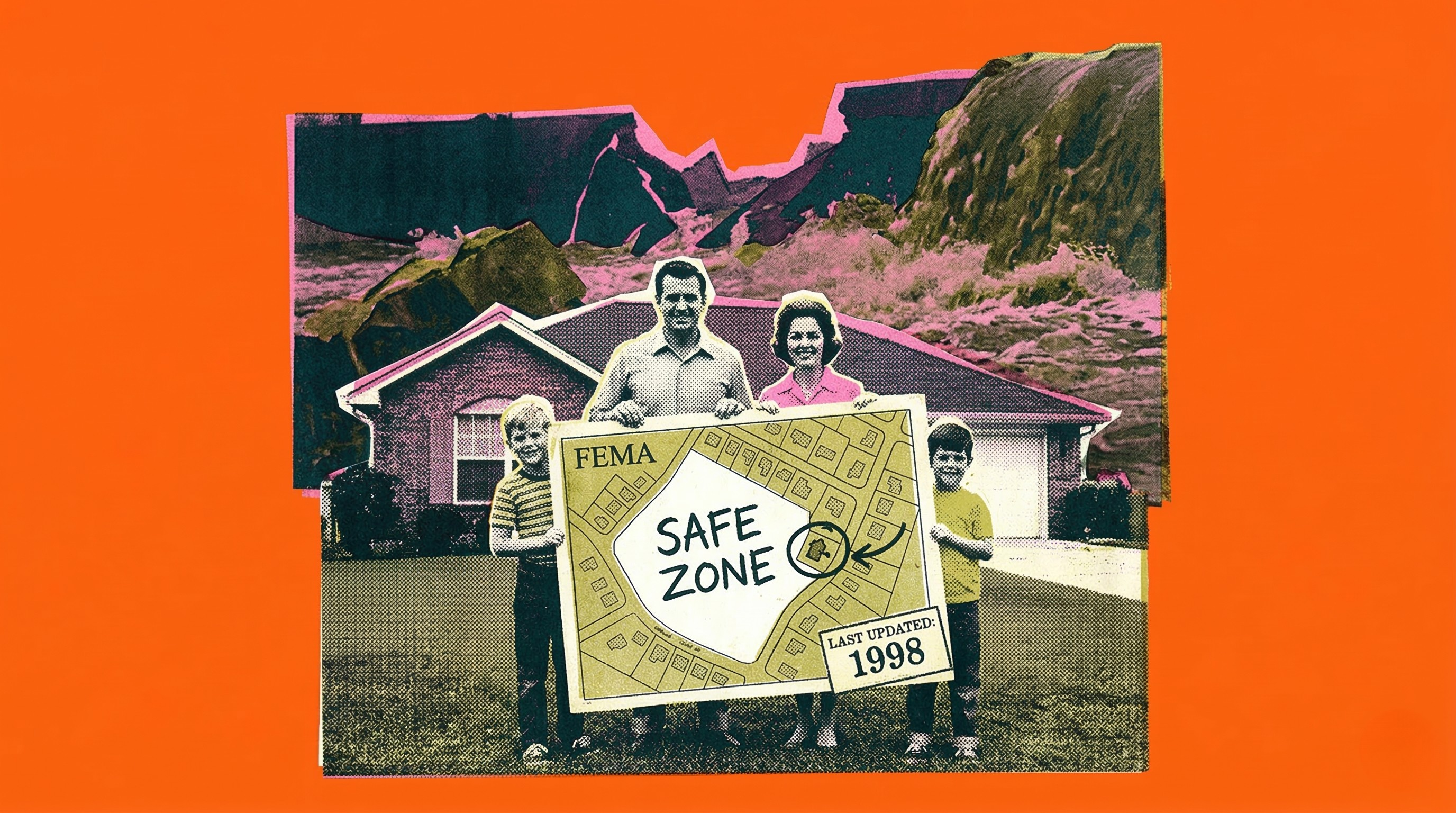
The Flood Maps Are Wrong and Everyone Knows It
Here is a fun experiment you can do at home. Go to FEMA's Flood Map Service Center -- it's online, it's free -- and look up your property. The map will tell you whether you live in a Special Flood Hazard Area, which determines whether your mortgage lender requires you to carry flood insurance. It will tell you your flood zone designation. It will give you a sense of your risk.
It will also, in many cases, be completely wrong.
FEMA's flood maps, known formally as Flood Insurance Rate Maps, are the foundation of the National Flood Insurance Program. They determine who has to buy flood insurance, how much it costs, and where developers can build. They are, without exaggeration, the most consequential maps in America. And a staggering number of them are based on data that is ten, twenty, or in some cases forty years old.
According to a 2020 analysis by the Association of State Floodplain Managers, approximately one-third of FEMA's flood maps are more than fifteen years old. Some have not been updated since the 1980s. In a country where climate change is redrawing flood boundaries in real time -- where a thousand-year storm now seems to happen every few years -- this is not a minor administrative oversight. It is a policy choice with consequences measured in billions of dollars and, occasionally, in lives.
How We Got Here
The story of FEMA's flood maps is, at its core, a story about money. Updating a flood map is expensive. It requires new hydrological surveys, updated topographic data, revised precipitation models, and extensive public comment. FEMA estimates that a typical map update costs between one hundred thousand and three hundred thousand dollars per county. There are over three thousand counties in the United States. Do the math.
Congress has never appropriated enough money to keep the maps current. In fiscal year 2024, FEMA's flood mapping budget was approximately two hundred and sixty million dollars. The agency's own estimates suggest it would need at least eight hundred million annually to maintain up-to-date maps nationwide. The shortfall is not a secret. FEMA has been saying this in congressional testimony, in budget requests, and in inspector general reports for over a decade. Congress has responded by not appropriating the money.
Why? Because updating flood maps has political consequences. When a map is updated and a neighborhood is reclassified into a higher-risk zone, the homeowners in that neighborhood are suddenly required to buy flood insurance, often at premiums of several thousand dollars a year. This makes homeowners angry. Angry homeowners call their representatives. Representatives call FEMA. FEMA, which depends on Congress for its budget, gets the message.
In 2013, after Congress passed the Biggert-Waters Flood Insurance Reform Act -- which, among other things, required FEMA to phase in actuarially sound rates -- the political backlash was so fierce that Congress passed a follow-up bill, the Homeowner Flood Insurance Affordability Act of 2014, that rolled back many of the reforms before they took effect. The message was clear: accurate flood maps and affordable flood insurance are, under current policy, mutually exclusive. Congress chose affordable. "Affordable" meaning "artificially cheap because we refuse to tell people the truth about their risk."
The Human Cost
The consequences of inaccurate flood maps are not evenly distributed. They fall hardest on people who can least afford them.
When Hurricane Harvey hit Houston in 2017, approximately seventy-five per cent of the flooded properties were outside FEMA's designated flood zones. These homeowners had been told, by the federal government's own maps, that they did not face significant flood risk. Many had declined to purchase flood insurance because they were told they didn't need it. They lost everything.
A similar pattern repeated with Hurricane Florence in North Carolina in 2018, with the Midwest floods of 2019, and with Hurricane Ida in Louisiana and the Northeast in 2021. In each case, the worst flooding occurred in areas that FEMA's maps had classified as low or moderate risk. In each case, the families who suffered the most were those who had trusted the maps.
"The maps create a false sense of security," says Dr. Chad Berginnis, executive director of the Association of State Floodplain Managers. "People look at the map, see that they're outside the flood zone, and conclude they're safe. But the map isn't measuring current risk. It's measuring what risk looked like when the map was drawn, which might have been twenty years ago, before the upstream development, before the climate shifted, before the drainage patterns changed."
What Would Fix This
The technology to produce accurate, frequently updated flood maps already exists. Private companies like First Street Foundation have built nationwide flood risk models that incorporate climate projections, current land-use data, and real-time hydrological modeling. Their assessments consistently identify millions of properties at risk that FEMA's maps miss.
The obstacle isn't technical. It's political. Accurate flood maps mean higher insurance premiums for millions of homeowners. Higher premiums mean political pain. And so we maintain the fiction -- a quiet, bipartisan agreement to let people build, buy, and live in places that will flood, and then act surprised when it happens.
FEMA's maps are wrong, and everyone knows it. The homebuilders know it. The insurers know it. The floodplain managers know it. Congress knows it. The only people who don't know it are the ones living in the flood zones that haven't been drawn yet. They'll find out when it rains.