Appearance
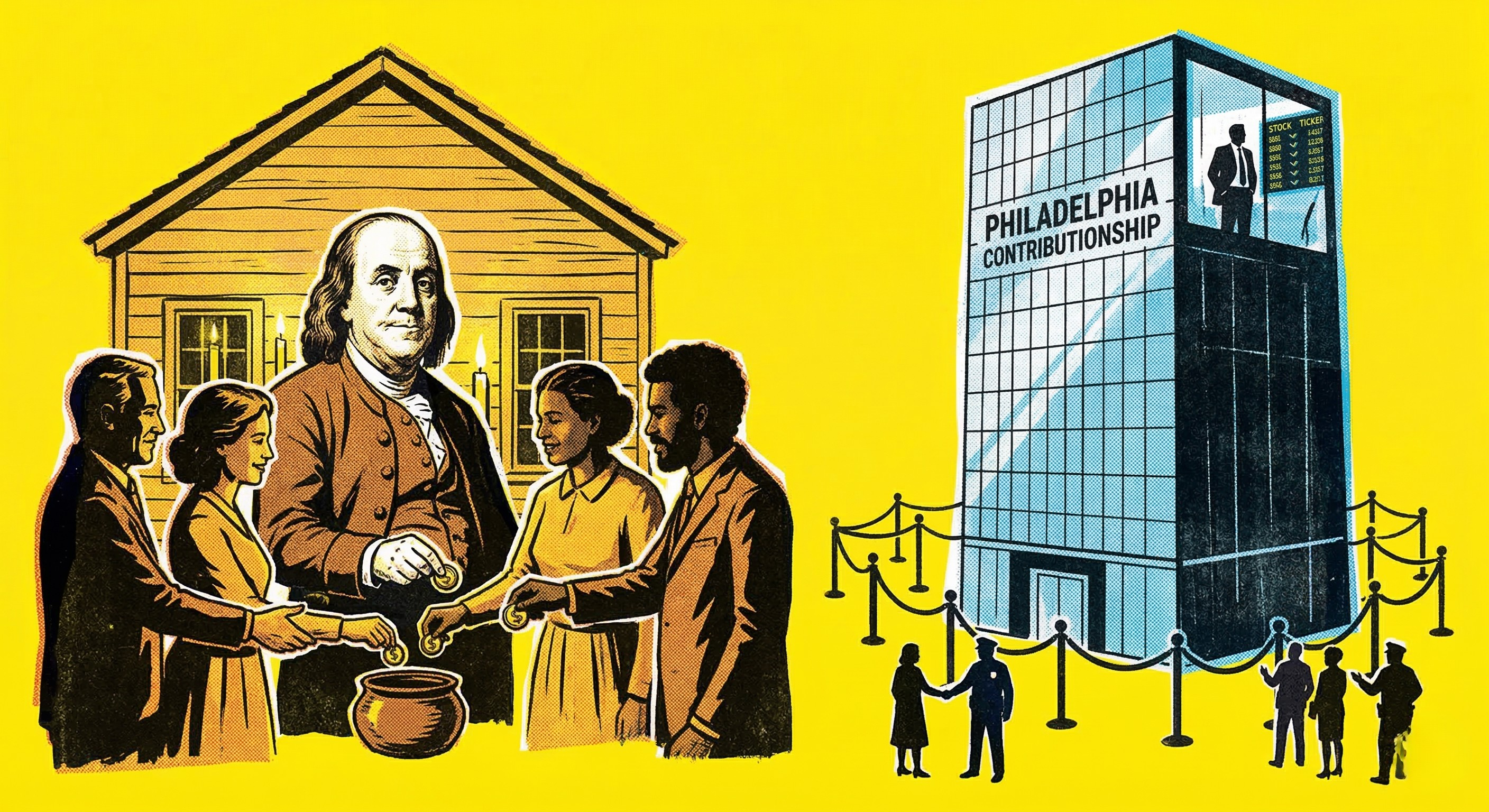
We Solved Insurance in 1752 and Then Forgot
In 1752, Benjamin Franklin -- who, to be fair, was good at most things -- helped found the Philadelphia Contributionship for the Insurance of Houses from Loss by Fire. It was one of the first insurance companies in America, and it worked like this: homeowners in Philadelphia pooled their money. If someone's house burned down, the pool paid to rebuild it. The company was owned by its policyholders. There were no shareholders. There were no stock options. There was no quarterly earnings call where an executive explained why paying claims had hurt profitability.
The Contributionship still exists. It has been in continuous operation for two hundred and seventy-four years. It still insures homes in Pennsylvania. It is still owned by its policyholders. And it is, by almost every measure, a better deal for consumers than the publicly traded insurance companies that now dominate the market.
So here's my question: if we figured this out in 1752, why did we forget?
How Mutuals Worked
The mutual insurance model -- where the policyholders own the company -- was the dominant form of insurance in America for most of the nation's history. As late as 1960, mutual companies wrote nearly half of all property and casualty insurance premiums in the United States. They had names you might recognize: State Farm (founded 1922 as a mutual), Nationwide (1926), Liberty Mutual (1912), USAA (1922). The model was simple: policyholders paid premiums, the company invested the premiums conservatively, claims were paid from the pool, and any surplus was either returned to policyholders as dividends or used to strengthen reserves.
The incentive structure was elegant. In a mutual company, there is no tension between the interests of policyholders and the interests of shareholders, because they are the same people. The company has no reason to deny legitimate claims, because the claimants are the owners. The company has no reason to maximize premiums beyond what's needed to maintain adequate reserves, because overcharging the policyholders is overcharging the owners.
Compare this to a publicly traded insurance company, where the CEO's compensation is tied to stock price, the stock price is tied to earnings, and earnings go up when the company collects more in premiums and pays less in claims. In this model, every claim paid is a dollar taken from shareholders. The incentive to deny, delay, and underpay is baked into the corporate structure. It's not a bug. It's the business model.
The Great Demutualization
Starting in the 1980s and accelerating through the 1990s and 2000s, a wave of "demutualizations" swept through the insurance industry. Mutual companies -- owned by their policyholders -- converted to stock corporations, owned by shareholders. The stated reasons were usually about access to capital. Stock companies could raise money by selling shares. Mutuals couldn't. In a consolidating industry, access to capital meant the difference between acquiring and being acquired.
But the real driver was simpler and less flattering: demutualization made people rich.
When a mutual company converts to a stock company, the ownership interest that policyholders hold in the mutual is converted to shares of stock. In theory, this gives policyholders a proportional stake in the new company. In practice, the executives who engineered the conversion often walked away with disproportionately large share allocations, stock options, and compensation packages.
When MetLife demutualized in 2000, CEO Robert Benmosche received a compensation package worth over fifty million dollars. Prudential's demutualization in 2001 made its executives hundreds of millions. John Hancock, Manulife, Sun Life -- the list goes on. In each case, policyholders received some shares, executives received a lot of shares, and a company that had existed to serve its members was transformed into a company that existed to serve its shareholders.
The result: the percentage of insurance premiums written by mutual companies fell from nearly fifty per cent in 1960 to roughly twenty-five per cent today. The cooperative model that Franklin helped pioneer -- the one that aligned the interests of the insurer with the interests of the insured -- has been systematically dismantled in favor of a model that does precisely the opposite.
The Numbers Don't Lie
Here's what the data shows, if anyone cares to look.
A 2023 study by the National Association of Mutual Insurance Companies found that mutual insurers returned an average of sixty-seven cents of every premium dollar to policyholders in the form of claims payments and dividends. Stock insurers returned fifty-four cents. That thirteen-cent gap is the cost of shareholder profit, executive compensation, and stock buybacks. Over the life of a policy, it adds up to thousands of dollars.
Mutual insurers also have higher customer satisfaction ratings, lower complaint ratios, and more stable pricing. They are less likely to withdraw from difficult markets. They are less likely to raise rates dramatically after a bad year. This isn't because mutual executives are morally superior to stock executives. It's because the incentive structure doesn't reward them for squeezing policyholders.
The Cooperative Revival
Against this backdrop, a small but growing number of new cooperative insurance ventures are trying to bring back the mutual model. Organizations like Canopy Cooperative in Vermont, Kin Insurance in Illinois, and Lemonade's original peer-to-peer model are experimenting with structures that put policyholders back at the center.
The challenges are real. Cooperatives can't raise capital by selling stock, which limits their growth. They require a level of member engagement that's difficult to sustain. They face regulatory frameworks designed for stock companies. And they're competing against incumbents with massive scale advantages.
But they have one advantage that no amount of capital can buy: their interests and their customers' interests point in the same direction. In an industry defined by the tension between who pays and who profits, that alignment is not a small thing. It is, in fact, the whole thing.
Benjamin Franklin understood this in 1752. He built a company where the people who paid for protection were the same people who controlled the company. It wasn't complicated. It wasn't disruptive. It was just... sensible.
We don't need to invent a better insurance model. We had one. We just need to remember why we abandoned it -- and who benefited when we did.