Appearance
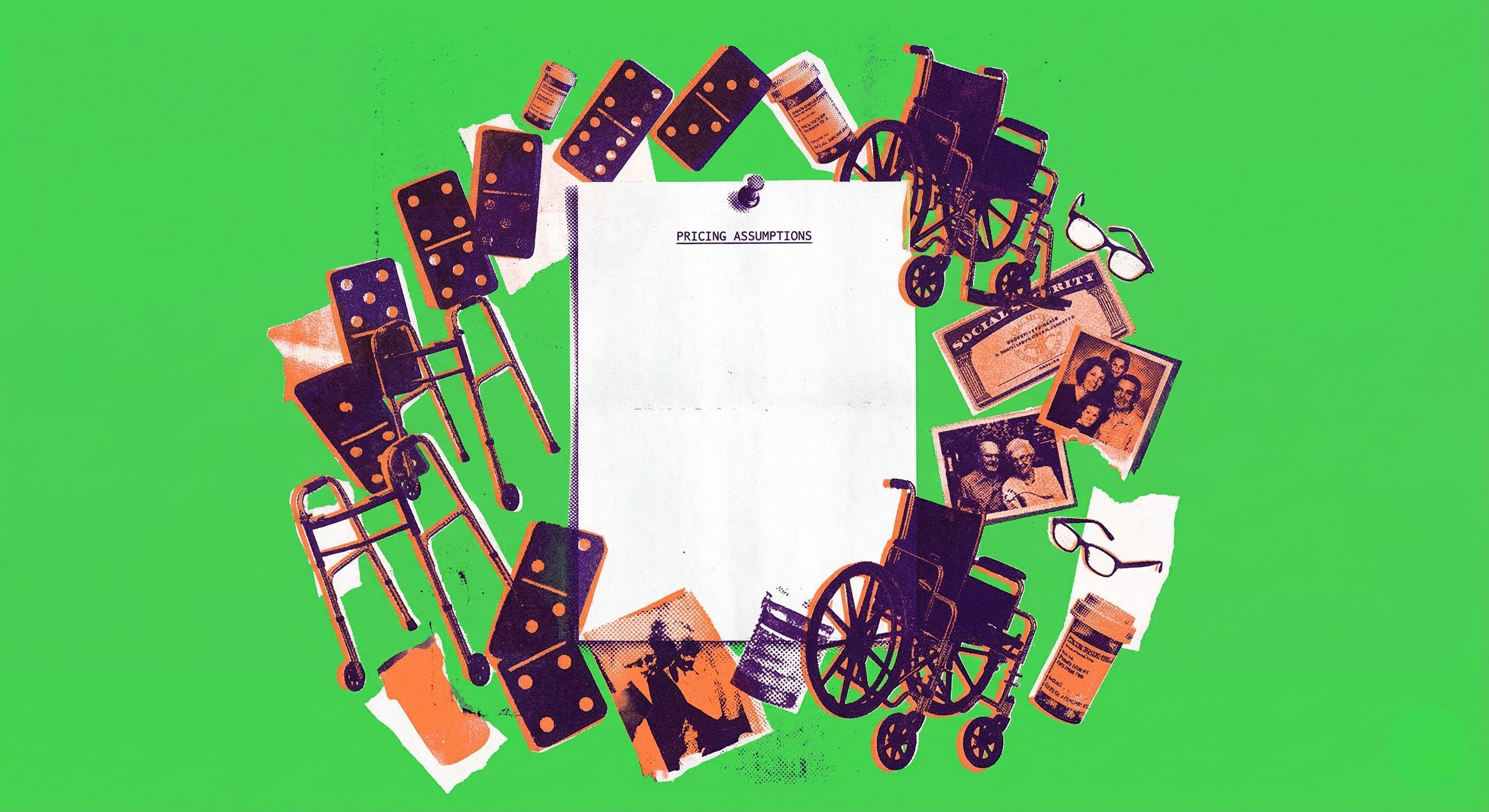
The Memo That Killed Long-Term Care
In 1990, a consulting actuary named Gerald Leppel circulated a memo to the senior leadership of several major insurance companies. The memo's subject line was "Long-Term Care Insurance: Pricing Assumptions and Profitability Projections." It was twelve pages long, dense with mortality tables and lapse-rate estimates, and it contained a prediction that would prove to be one of the most consequential miscalculations in the history of the American insurance industry.
Leppel's memo argued that long-term care insurance -- policies that cover nursing homes, assisted living, and in-home care -- could be profitably priced using three key assumptions. First, that a significant percentage of policyholders would let their policies lapse before filing a claim. Second, that interest rates would remain at or near the seven per cent levels prevailing in 1990. Third, that improvements in life expectancy would slow, keeping the average duration of long-term care claims manageable.
He was wrong about all three.
The Three Wrong Bets
Let's take them one at a time, because each one is its own little catastrophe.
The lapse rate. Leppel and his contemporaries assumed that somewhere between four and eight per cent of policyholders would drop their coverage each year -- either because they forgot to pay, decided they didn't need it, or found it too expensive. This assumption was based on the lapse rates for other types of insurance, particularly life insurance. It seemed reasonable. It was wildly optimistic.
People who buy long-term care insurance tend to be planners. They bought the policy specifically because they're worried about needing care in old age. These are not people who casually let their coverage lapse. Actual lapse rates turned out to be between one and two per cent -- a fraction of what was projected. Which meant far more people held onto their policies, which meant far more people eventually filed claims.
The interest rates. In 1990, a ten-year Treasury bond yielded about eight per cent. Insurers priced their long-term care products assuming they could invest the premiums they collected at similar rates and earn enough to cover future claims. Then interest rates spent the next three decades falling. By 2020, the ten-year Treasury was yielding under one per cent. The investment income that was supposed to subsidize future claims simply evaporated.
The life expectancy. This is the big one. Leppel's projections assumed that Americans' life expectancy would increase slowly, if at all. Instead, medical advances -- particularly in cardiac care, oncology, and pharmaceuticals -- extended average lifespans significantly. People lived longer. They needed care for longer. A claim that actuaries modeled as lasting two years might last five. Or eight. Or twelve.
Each of these miscalculations, on its own, would have been a problem. Together, they were a death sentence for the industry.
The Collapse
By the early 2000s, the math had become inescapable. Insurers who had sold long-term care policies in the 1980s and 1990s were sitting on massive liabilities -- promises to pay for care that would cost far more than the premiums they had collected. They had two options: raise premiums on existing policyholders, or eat the losses.
They chose to raise premiums. Repeatedly. Dramatically.
Between 2010 and 2025, long-term care insurance premiums increased by an average of one hundred and thirty per cent. Some policyholders saw their premiums triple. People who had been paying five hundred dollars a month for a decade were suddenly being asked to pay fifteen hundred. Many of these policyholders were in their seventies and eighties, living on fixed incomes. They had bought the policies specifically to avoid being a financial burden on their families. Instead, the premiums became the burden.
Simultaneously, insurers stopped selling new policies. In 2000, more than a hundred companies offered long-term care insurance. By 2025, fewer than a dozen did. The product that was supposed to solve America's long-term care crisis had, through a combination of actuarial hubris and financial mismanagement, destroyed itself.
Who Pays
Here's where the story gets truly grim. The collapse of the long-term care insurance market hasn't eliminated the need for long-term care. It has just shifted the cost.
Today, the primary payer for long-term care in America is Medicaid -- the government health program for low-income Americans. Medicaid was never designed to be a long-term care program. But because private insurance failed and there is no other public alternative, Medicaid now covers approximately sixty per cent of all nursing home residents in the United States. To qualify, you generally have to spend down your assets to poverty level. Which means that for millions of middle-class families, the path to long-term care runs through financial ruin.
The total cost of long-term care in the United States exceeds four hundred billion dollars annually. It is the largest uninsured risk facing American families, and it is uninsured in large part because of a twelve-page memo written in 1990 by a man who underestimated how long people would live, how long they'd keep paying their premiums, and how far interest rates would fall.
Gerald Leppel retired in 2007. He receives, one assumes, excellent health benefits.
What Should Have Happened
The failure of private long-term care insurance was not inevitable. It was the result of specific, identifiable pricing decisions made by specific, identifiable people. And it could have been avoided.
In 2013, the Commission on Long-Term Care -- appointed by Congress -- recommended the creation of a public long-term care insurance program, modeled loosely on Social Security. Premiums would be collected through payroll taxes. Benefits would be available to all Americans who had paid into the system. Risk would be pooled nationally, eliminating the adverse selection problem that plagues private insurance.
Congress thanked the commission for its work and did nothing. The insurance industry lobbied against the proposal, arguing that a public option would crowd out private coverage. This was, to put it charitably, a creative argument from an industry that had already crowded itself out of the market.
Meanwhile, other countries have solved this problem. Germany introduced mandatory long-term care insurance in 1995. Japan did the same in 2000. Both programs are publicly administered, universally available, and funded through a combination of payroll taxes and general revenue. They're not perfect. But they exist, which puts them meaningfully ahead of America's approach, which is to pretend the problem doesn't exist until Grandma falls and breaks a hip.
The memo is still out there, presumably in some actuary's filing cabinet. Its assumptions have been proven wrong in every particular. But the consequences -- the premium hikes, the collapsed market, the millions of families with no coverage and no plan -- those are still very much with us.