Appearance
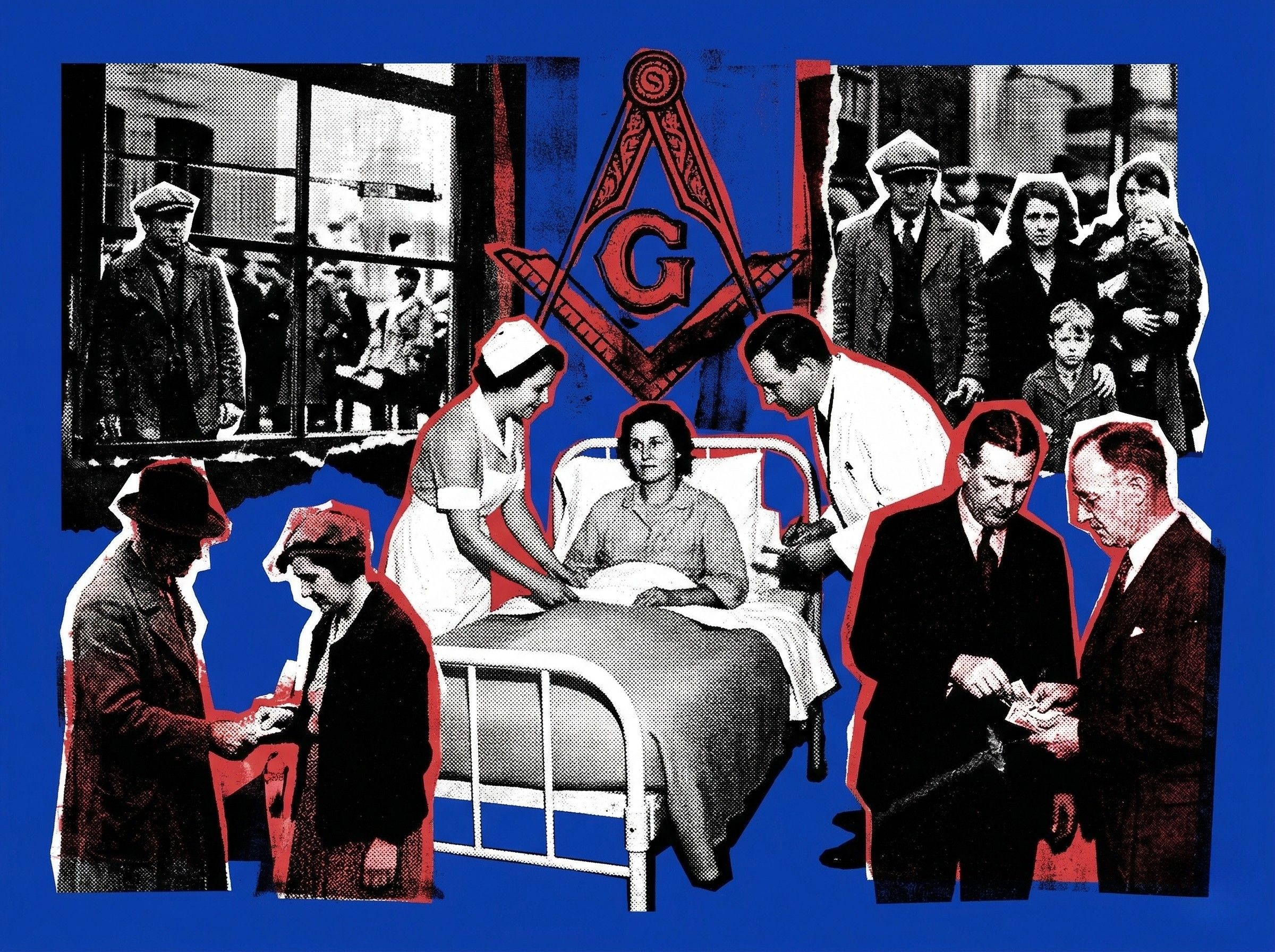
When Your Lodge Was Better Than Your Health Insurance
In 1934, one of the ugliest years of the Great Depression, millions of Americans were living one emergency away from ruin. Savings were gone. Wages had collapsed. Jobs were scarce. A hospital stay was not just a medical problem. It was an economic catastrophe waiting to happen.
Ruth Papon of Olathe, Kansas, got sick anyway.
She went into the Security Benefit Association hospital in Topeka for what records called a "4-in-1 major operation." She survived the surgery, went home, then came back with a severe case of pneumonia. She survived that too. Months later, she wrote about the doctors and nurses with obvious gratitude. They had saved her life, she said, and the hospital had a "homey" feeling that other hospitals lacked.
That detail matters. Ruth Papon was not rich. She was not unusually lucky. She had something millions of other Americans also had in the late nineteenth and early twentieth centuries: membership in a fraternal society.
And for a long stretch of American history, that meant something close to what people now wish health insurance meant. It meant real protection.
The Lodge Was Not Just a Club
When modern Americans hear "fraternal society," they tend to picture robes, handshakes, and men saying cryptic things in wood-paneled rooms. That existed. But it misses the main point.
Fraternal societies were mutual-aid institutions. They had rituals, yes. They had lodges and elected officers and passwords and elaborate ceremonies. But they also collected dues, paid sickness benefits, covered funerals, provided life insurance, supported widows and orphans, and in some cases built hospitals, clinics, and sanitariums.
The lodge was not merely symbolic community. It was infrastructure.
By 1920, Americans carried more than $9 billion in life insurance through fraternal societies. Lodges were also major providers of health-related benefits. Some paid cash when members were too sick to work. Others arranged doctor visits. A few, like the Security Benefit Association and the Modern Woodmen of America, went further and built medical institutions of their own.
This was not a boutique arrangement for the respectable middle class. One out of three adult men in America may have belonged to a fraternal society around 1920. Black Americans built strong lodge traditions of their own. Immigrant communities from Southern and Eastern Europe relied heavily on ethnic benefit societies. Women joined female or mixed fraternal bodies that offered the same basic promise: if trouble came, the group would not leave you alone with it.
That promise is more radical than it sounds.
Why Fraternal Welfare Worked
The standard story of American social policy goes something like this: before the New Deal and the modern welfare state, ordinary people were mostly on their own, exposed to the market and dependent on charity. That is only partly true.
What many Americans had instead was a dense world of voluntary mutual aid.
The crucial difference between fraternal aid and ordinary charity was reciprocity. Charity is vertical. Someone with more gives to someone with less, often with strings attached and usually with a healthy dose of humiliation. Fraternal aid was horizontal. The people paying into the system and the people drawing from it usually came from the same neighborhoods, the same occupations, and the same general circumstances.
You were not a case file. You were a member.
That changed the emotional meaning of assistance. The dues you paid last year might help another member this year. The help you received this year might be repaid, indirectly, by your dues next year. The donor and the recipient were often the same person at different moments in life.
That is why the lodge could do something public relief and private charity usually could not: provide material help without stripping people of dignity.
It also created incentives that are mostly gone now. Fraternal societies rewarded thrift, regular contribution, participation, and a sense of obligation to people outside one's immediate household. If a member got sick, the lodge did not just send a check. In many cases it showed up. Members harvested crops, chopped wood, visited the ill, buried the dead, and kept struggling families from sliding over the edge.
Insurance, in other words, still had a social body attached to it.
The Medical Model We Forgot
The most interesting part of this story is not that lodges paid death benefits. Lots of institutions can write a check after a funeral. The interesting part is that some fraternal societies got directly involved in delivering care.
That is almost unimaginable now.
Today, American health care is built on third-party payment. Your employer chooses a plan. The insurer decides what is covered. The hospital bills a rate nobody understands. The patient receives an explanation of benefits written in a dialect of English designed to induce despair. Everyone involved claims to be managing risk. Nobody seems responsible for care.
Fraternal medicine worked differently. It was not universal and it was not perfect, but it was legible. Members paid in. The institution served members. In some cases, the same organization that collected dues also operated the facility where treatment was delivered. The connection between contribution and benefit was visible. So was the human relationship between the organization and the person it existed to protect.
This is part of why Ruth Papon described the hospital as "ours."
Nobody says that now about UnitedHealthcare.
The old lodge model had limits, of course. It depended on stable communities, repeated interaction, and cultural norms of participation that are much weaker today. Benefits were uneven. Coverage could be narrow. Many societies excluded people by race, religion, ethnicity, or occupation, even as others were built precisely by and for excluded groups. No serious person should romanticize the entire system.
But it is still worth noticing that fraternal societies accomplished something modern America still struggles to do: they built low-cost, large-scale networks of care among people who were not wealthy.
Why the Lodge Died
If the model worked as well as it did, why did it fade?
Part of the answer is scale. Industrial medicine became more expensive, more specialized, and more centralized. The local lodge that could manage a doctor visit or a hospital bed in 1910 was badly outmatched by the economics of postwar medicine.
Part of the answer is the state. As government welfare programs expanded and commercial insurance became more dominant, fraternal societies lost the practical niche that had made them indispensable.
And part of the answer is cultural. Fraternalism depended on habits that modern life steadily eroded: long-term membership, face-to-face governance, stable local institutions, and the expectation that ordinary people should help administer one another's welfare rather than outsource the entire job to bureaucracies or corporations.
By the late twentieth century, many lodges still existed, but mostly as social organizations. The mutual-aid machinery that once justified their existence had largely been stripped away.
What remained was the shell.
What This History Is Actually Good For
There is no serious path back to 1934. Nobody is going to rebuild the old fraternal world exactly as it was, and nobody should pretend otherwise. The lodge belonged to a specific historical environment that no longer exists.
But history is still useful when it exposes a bad assumption.
The bad assumption here is that there has never been an American alternative to bureaucratic charity on one side and corporate insurance on the other. There was. It was imperfect. It was uneven. But it was real, and for millions of people it worked.
Fraternal societies proved that poor and working-class Americans could build durable systems of mutual protection without waiting for either philanthropists or shareholders to save them. They proved that social welfare did not have to mean humiliation. They proved that medical care could be organized around membership and reciprocity rather than opacity and extraction.
Most of all, they proved that insurance used to be about more than financial engineering. It used to be about belonging to an institution that recognized you, expected something of you, and would show up when your life went sideways.
That world is gone. The needs it answered are not.