Appearance
Why Your Health Insurance Doesn't Cover That
If you've ever stared at a medical bill and thought, "Why doesn't my insurance cover this?" I want you to know that the answer traces back to a bureaucratic workaround from 1943, a tax loophole that nobody planned, and a series of decisions by people who are all dead now. You're not dealing with a system. You're dealing with an accident that nobody has cleaned up in eighty-three years.
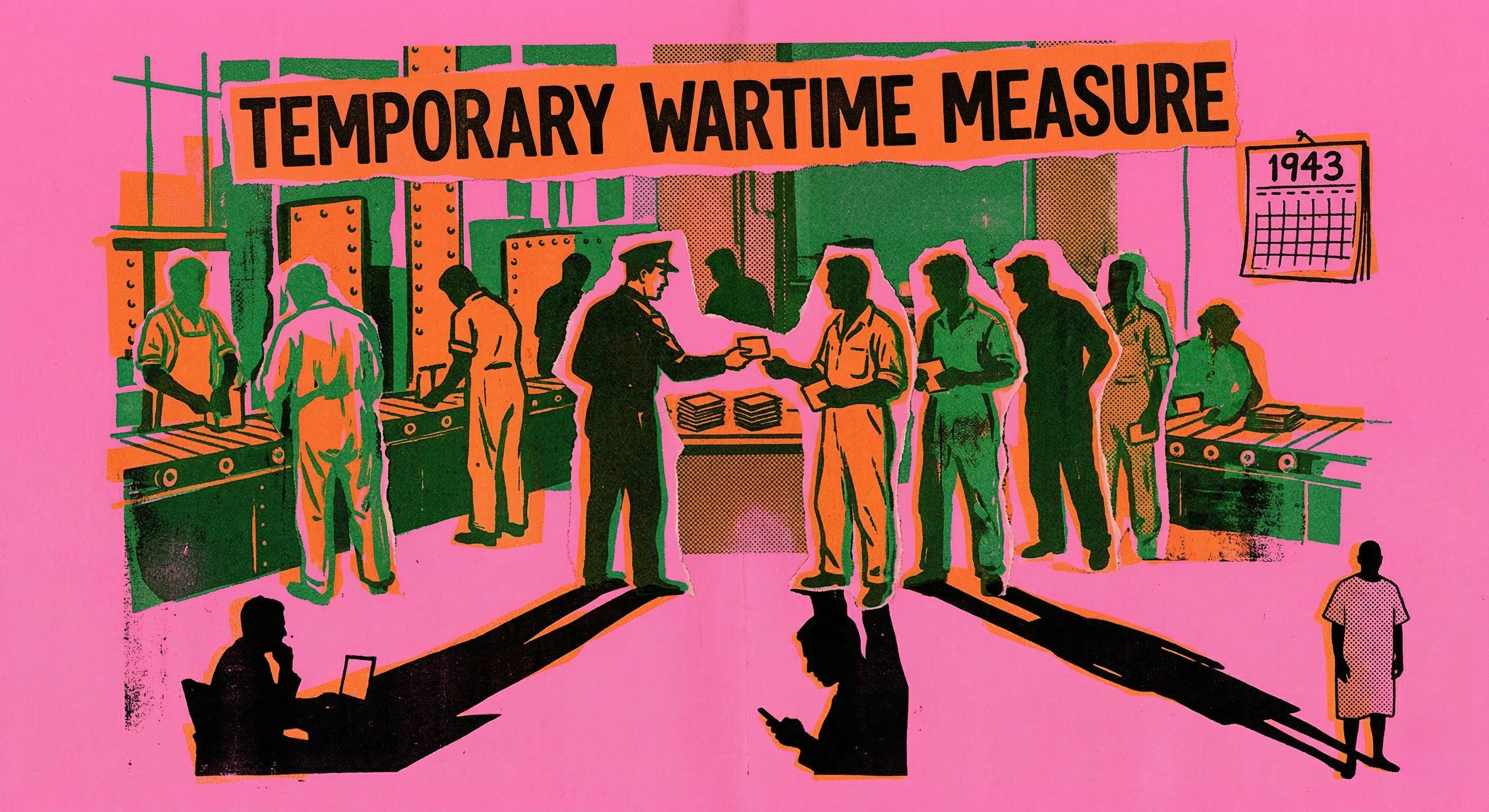
Here's the origin story. During World War II, the federal government imposed wage and price controls to prevent wartime inflation. Employers who wanted to attract scarce workers couldn't offer higher salaries -- that was illegal. So they offered health benefits instead. In October 1943, the War Labor Board ruled that employer contributions to health insurance did not count as wages for the purposes of wage controls. It was a workaround. A hack. The bureaucratic equivalent of propping up a table leg with a folded napkin.
Then, in 1954, Congress passed the Internal Revenue Code, Section 106, which excluded employer-provided health insurance from taxable income. This was not the result of a grand policy debate about the best way to organize health care in the richest country in the world. It was a tax clarification that codified what had already become standard practice. Nobody voted on whether tying health insurance to employment was a good idea. It just happened, and then it became permanent, and then one hundred and fifty-seven million Americans ended up depending on it.
The Design Flaw
The problem with a system designed by accident is that nobody designed it to work well. And the employer-based model has a structural flaw so fundamental that it's almost funny: it ties your access to health care to the one thing in your life most likely to change without warning.
You lose your job. You lose your insurance. You get sick. You can't work. You lose your insurance. You start a business. You lose your insurance. You get divorced from the spouse whose employer provided your coverage. You lose your insurance. In what universe does this make sense?
The COBRA Act of 1985 was supposed to address this by allowing people to continue their employer-sponsored coverage for up to eighteen months after leaving a job. The catch? You have to pay the full premium yourself -- the portion your employer was subsidizing plus your own share. The average COBRA premium for family coverage in 2025 was twenty-four thousand dollars per year. For someone who just lost their job. Truly, a masterpiece of policy design.
Who Benefits
Here's the thing about the employer-based system that nobody in Washington will say out loud: it survives not because it works, but because the people who benefit from it are the people who make the rules.
The tax exclusion for employer-sponsored insurance is the single largest tax expenditure in the federal budget -- roughly three hundred and fifty billion dollars per year in foregone revenue. That money disproportionately benefits higher-income workers, because the tax savings are larger for people in higher tax brackets. A CEO whose employer provides a gold-plated health plan saves thousands of dollars a year in taxes. A minimum-wage worker whose employer doesn't offer insurance saves nothing.
Insurance companies benefit because the employer-based system gives them a guaranteed customer acquisition channel. Employers do the work of enrolling employees, collecting premiums, and managing the administrative burden. The insurers just collect the checks.
Employers themselves have mixed feelings, but large employers -- the ones with lobbying budgets -- generally prefer the current system because it gives them leverage over their workforce. Health insurance is the golden handcuff. It keeps people in jobs they might otherwise leave. There's a term for this in economics: "job lock." It is estimated to affect between five and twelve million American workers at any given time. People who stay in jobs they want to leave, or decline to start businesses they want to start, because they cannot afford to lose their employer-sponsored health insurance.
The Road Not Taken
It didn't have to be this way. In 1945, President Harry Truman proposed a national health insurance program that would have covered all Americans regardless of employment status. The American Medical Association called it "socialized medicine" and spent the equivalent of thirty-five million dollars in today's money on an advertising campaign to kill it. They succeeded.
In 1971, Senator Ted Kennedy introduced a single-payer health insurance bill. President Nixon countered with a proposal to mandate employer-sponsored coverage. Neither passed. In 1993, the Clinton administration proposed a managed-competition model. It died in Congress. At every turn, the employer-based system survived not because anyone argued it was the best approach, but because changing it was politically harder than keeping it.
The Affordable Care Act of 2010 was the most significant reform in the system's history, and it explicitly preserved the employer-based model. It had to. The political cost of disrupting employer-sponsored coverage -- of telling one hundred and fifty million Americans that their insurance was going to change -- was a price no politician was willing to pay.
What Now
We are stuck with a health insurance system that was never designed, never debated, and never chosen. It emerged from a wartime wage freeze, was cemented by a tax code provision that nobody thought through, and has survived for eighty-three years because the people who benefit from it are better organized than the people who are harmed by it.
Every other wealthy country on earth figured this out. Not one of them ties health insurance to employment. Not one. The United States is the only country that looked at the problem of how to insure its citizens and said, "I know -- let's make it depend on whether they have a job, and which job it is, and whether that particular employer feels like offering benefits."
The War Labor Board members who made that ruling in 1943 were solving a short-term problem. They did not intend to design America's health care system. Nobody asked them to. But that is what they did, and we have been living with the consequences -- the coverage gaps, the job lock, the medical bankruptcies, the fundamental absurdity of it all -- ever since.